
Professional Staging Guide for Colorado Springs Sellers (2026)

Professional Staging Guide (2026): How Home Staging Works When You Sell in Colorado Springs
Professional staging means preparing and furnishing your home so buyers can picture themselves living there, both in the listing photos and when they walk through the door. It isn't decorating, and it isn't about your taste. It's marketing. In a national survey of REALTORS, 83% of buyers' agents said staging makes it easier for buyers to visualize a property as their future home, and that's the whole game.
This guide covers what professional staging actually includes, what it costs, which rooms matter most, how it works for occupied versus vacant homes in Colorado Springs, and when it's worth it (and when it's not). We're Crystal Sisler and Shawn Bedel with Everyday Properties & Investments, powered by eXp Realty. We also own Everyday Staging, a professional home staging company, so yes, we have opinions. We'll keep them practical.
What Is Professional Home Staging?
Professional home staging is the process of arranging furniture, decor, lighting and layout so a home shows its best features and minimizes its weak spots. A stager looks at the house the way a buyer will: how the rooms flow, what the photos will capture, where the eye lands first, and what questions a buyer will have (like "will a king bed fit in here?").
Staging usually falls into one of three buckets:
- Consultation staging. A stager walks the home and gives you a room-by-room plan. You do the work using your own furniture and decor.
- Occupied staging. You still live in the house. The stager rearranges and edits what you have, removes what's working against you, and brings in accent pieces like art, lamps, bedding, pillows and rugs.
- Vacant staging. The home is empty, and the stager brings in furniture and decor for key rooms, then removes it after the home sells or the contract period ends.
There's also virtual staging, where furniture is digitally added to photos of empty rooms. We'll cover that separately, because it comes with its own rules and limits.
Does Staging Actually Help a Home Sell?
Short answer: the data says it usually helps, but it isn't magic, and anyone promising a specific dollar amount is guessing.
The most widely cited source is the National Association of REALTORS 2025 Profile of Home Staging, based on a February 2025 survey of REALTORS nationwide. Here's what agents reported:
|
What NAR asked |
What agents reported |
|---|---|
|
Does staging help buyers visualize the home? |
83% of buyers' agents said it makes it easier |
|
Did staging increase the dollar value offered? (sellers' agents) |
19% saw a 1% to 5% increase, and 10% saw a 6% to 10% increase. 30% saw no impact on dollar value. |
|
Did staging change time on market? (sellers' agents) |
49% said it reduced time on market (30% slightly, 19% greatly) |
|
Median cost of a staging service |
$1,500, compared to $500 when the listing agent handled staging themselves |
A couple of honest notes on those numbers. First, they're national, not Colorado Springs specific. Second, they're agent perceptions from a survey, not a controlled experiment. Still, the direction is pretty consistent: staging tends to help buyers connect with a home, and very few agents report it hurting a sale (NAR found just 1% of sellers' agents said it had a negative impact on dollar value).
Our take? Staging is not going to fix an overpriced listing or a roof that needs replacing. What it does is make sure buyers see the house at its best, in the photos and in person, so your price and condition get a fair shot.
Why Staging Starts With the Listing Photos
Most buyers meet your home online first. NAR's staging report found that 73% of buyers' agents considered photos more important or much more important than other listing materials, ahead of physical staging, video and virtual tours. Staging and photography are a tag team. A beautifully staged room shot badly still looks flat, and a great photographer can't make a cluttered room look spacious.
When we're preparing one of our listings, staging is planned with the camera in mind: what's in the first photo, which angle shows the room's real size, and whether a window with a Pikes Peak view is framed or blocked by a dresser. In Colorado Springs, that view (or a great deck, or a big backyard) is often a selling point, so we stage to show it off, not hide it.
Which Rooms Matter Most to Stage?
If your budget or time is limited, focus where buyers focus. According to NAR, buyers' agents rated these rooms as "very important" to stage:
- Living room: 37%
- Primary bedroom: 34%
- Kitchen: 23%
Sellers' agents reported that the rooms most commonly staged are the living room (91%), primary bedroom (83%), dining room (69%) and kitchen (68%). Guest bedrooms were the least likely to be staged.
Living Room
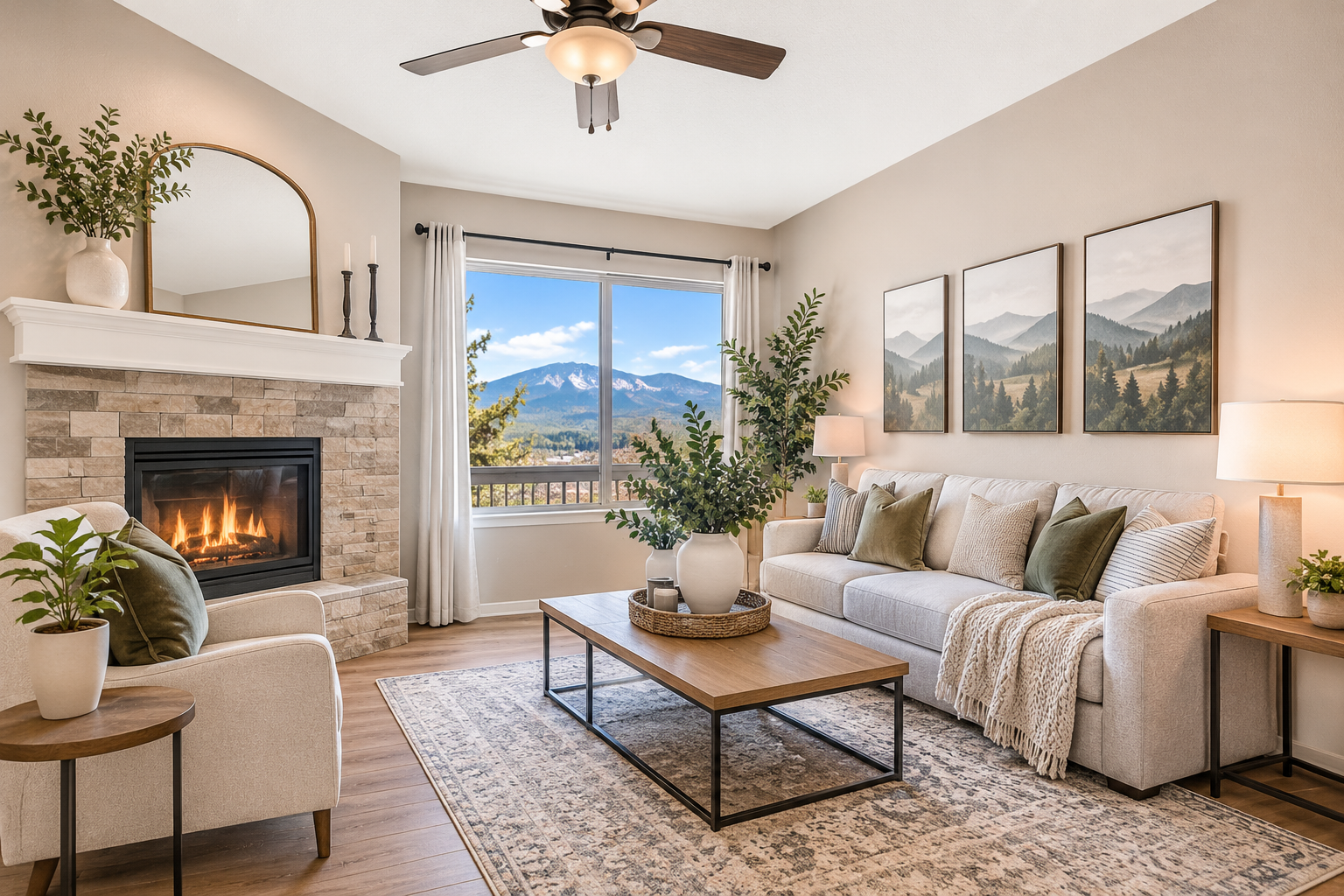
This is usually the first big photo and the first room buyers walk into. Scale furniture to the space, pull pieces off the walls if it helps define a conversation area, and keep the walkways open. If you have a fireplace, make it the focal point and keep the mantel simple.
Primary Bedroom
Buyers want calm. Crisp neutral bedding, matching nightstands and lamps, and nothing stored under the bed or piled in the corners. If the room is large, a small seating area can show off the square footage.
Kitchen
Kitchens are less about furniture and more about editing. Clear the counters down to two or three items, remove magnets and papers from the fridge, and make sure the lighting works. Buyers open cabinets, so tidy those too.
Basements and Bonus Spaces
Plenty of Colorado Springs area homes have finished basements, lofts or flex rooms. These spaces are where buyers get confused if they're empty or full of storage. Give each one a clear purpose, like a family room, office, gym or guest space, so buyers can see the value they're paying for.
Occupied Staging vs Vacant Staging
Most sellers we talk with are still living in the home while it's listed. That's completely workable, it just looks different.
|
Occupied Staging |
Vacant Staging |
|
|---|---|---|
|
Who it's for |
Sellers living in the home during the sale |
Sellers who have already moved, relocations, PCS moves, estates, investment properties |
|
What the stager uses |
Mostly your furniture, plus accent pieces |
The stager's furniture and decor |
|
Biggest challenge |
Keeping it show-ready while you live there |
Coordinating delivery and pickup, cost of rental inventory |
|
Biggest win |
Lower cost, and the home still feels lived in, just elevated |
Empty rooms stop looking smaller and colder than they really are |
Vacant homes deserve a special mention. Empty rooms are hard to read in photos. Buyers can't tell if their couch fits, and every scuff on the wall stands out. For our military clients who have already PCSed out of Fort Carson, Peterson Space Force Base, Schriever Space Force Base or the Air Force Academy, and for out-of-state sellers, vacant staging is often the difference between a listing that looks like a home and one that looks like a rental between tenants.
What to Do Before the Stager Shows Up
Staging works best on a clean, repaired, decluttered house. Here's the prep order we recommend:
- Declutter hard. If you haven't used it this season, pack it. Pre-packing is a head start on your move anyway.
- Depersonalize. Family photos, collections, kids' artwork, diplomas and very personal decor go in a box. You're not erasing yourself, you're making room for the buyer's imagination.
- Handle small repairs. Burned-out bulbs, sticky doors, dripping faucets, loose handles, and obvious wall damage. Buyers notice little stuff and assume there's big stuff.
- Deep clean. Windows, baseboards, grout, light fixtures, and carpets. Professional cleaning is one of the best returns on prep money.
- Neutralize where it counts. Bold paint colors in main living areas can distract buyers. Not every wall needs repainting, but loud ones usually do.
- Fix the front. Curb appeal is staging too: trimmed shrubs, a swept porch, a clean front door, working exterior lights, and a fresh doormat.
One local note from us that has nothing to do with staging theory and everything to do with real life: if you're in an HOA or covenant-controlled community, keep up with the rules while you're listed. We live in Meridian Ranch, and we've personally received more than a handful of covenant notices for not pulling our trash cans back up the same day they were emptied. Trash cans sitting at the curb are not the vibe you want in your front exterior photo, either.
What About Virtual Staging?
Virtual staging digitally adds furniture and decor to photos of empty rooms. It's cheaper than physical staging and can be a smart option for a vacant home on a tighter budget.
The catch is that buyers eventually show up in person. If the photos show a cozy, furnished living room and the buyer walks into an empty one, the room can feel smaller and more bare than they expected. Virtual staging helps the click. Physical staging helps both the click and the showing.
There are also rules. Colorado's largest MLS, REcolorado, allows virtually staged photos but says permanent objects can't be removed, landscaping can't be altered, and improvements that don't exist can't be added. Rules differ by MLS and can change, especially as AI photo editing becomes more common, so always confirm the current requirements with your listing agent. Our rule of thumb: virtual staging can add furniture, but it should never hide a defect or change the house itself. The REALTOR Code of Ethics requires agents to present a true picture in their advertising, and that applies to photos.
How Much Does Professional Staging Cost?
Nationally, NAR reported a median cost of $1,500 for a staging service in its 2025 report. Actual cost depends on:
- Whether the home is occupied or vacant
- How many rooms are staged
- Home size and price point
- How long the furniture stays (vacant staging is often priced for an initial period, with a monthly fee after)
- Delivery, setup and removal logistics
Who pays varies too. NAR found that some sellers pay for staging themselves before listing, some agents personally offer staging, and many say it depends on the situation. With us, professional home staging is included in our listing packages, because we own Everyday Staging and we think it's too important to treat as an add-on.
When Staging Is Worth It (And When It Isn't the Priority)
Here's where we'll be straight with you. Staging is a strong tool, but it's not always the first dollar you should spend.
Staging Is Usually Worth It When:
- The home is vacant
- Rooms have awkward layouts or unclear purposes
- The furniture is oversized, dated or very personal
- You're competing with new construction model homes nearby, which is common in fast-growing areas like Peyton, Falcon and the northeast side of Colorado Springs
- The home is at a higher price point where buyers expect a polished presentation
Fix These Before You Worry About Staging:
- Pricing. Staging won't save an overpriced home. Price is still the biggest lever.
- Major condition issues. Roof, HVAC, water heater, or anything a buyer's inspector will flag in bold. A pretty throw pillow doesn't distract from a furnace that's on its last legs.
- Odors. Pets, smoke and mustiness kill showings. Staging can't cover a smell.
Staging Mistakes We See Sellers Make
- Staging for themselves. Your favorite bold accent wall is lovely. It's also not for sale.
- Too much furniture. Rooms look smaller when every wall has something on it. Edit first, then style.
- Ignoring the garage and closets. Buyers open everything. A garage stacked to the ceiling says "not enough storage."
- Staging once, then living normally. In an occupied home, staging only works if it's show-ready for each showing. Make a quick 15-minute reset routine.
- Skipping the outside. Your front exterior is usually the first photo. Treat it like a room.
- Letting virtual staging do too much. Furniture only. Never alter the house itself.
How Staging Fits Into the Rest of Your Listing Plan
Staging sits in the middle of the listing timeline. A typical order looks like this:
- Listing consultation and pricing strategy
- Repairs, decluttering and cleaning
- Staging consultation, then staging installation
- Professional photography, video and any other marketing media
- Listing goes live and showings begin
- For vacant staging, furniture removal after closing or as agreed
The key is that staging happens before photos. Photograph the house once, staged and ready, so the listing launches strong instead of getting reshot a week later.
Frequently Asked Questions
Is home staging worth it in Colorado Springs?
For many sellers, yes, especially for vacant homes or homes competing with nearby new construction. National data from NAR shows most buyers' agents believe staging helps buyers picture themselves in a home, and about half of sellers' agents said it reduced time on market. Results vary by home, price and condition, so it's best evaluated as part of your overall listing plan.
How much does it cost to stage a house?
NAR's 2025 Profile of Home Staging reported a national median of $1,500 for a staging service. Your actual cost depends on the home's size, whether it's occupied or vacant, how many rooms are staged, and how long the furniture stays. Some listing agents, including us, include staging in their listing packages.
Can I stage my home while I'm still living in it?
Yes, and most sellers do. Occupied staging uses much of your own furniture, removes what's distracting, and adds accent pieces. The trick is keeping it show-ready day to day, which is easier if you pack and store extras before the listing goes live.
What rooms should I stage first?
Start with the living room, primary bedroom and kitchen. Those are the rooms NAR found buyers' agents rated most important. After that, focus on any space with an unclear purpose, like a loft, bonus room or finished basement.
Is virtual staging allowed on Colorado MLS listings?
REcolorado allows virtually staged photos as long as the edits don't remove permanent features, alter landscaping, or add improvements that don't exist. MLS rules vary and can change, so confirm current requirements with your listing agent before using virtual staging.
How long does staging stay in a vacant home?
It depends on the staging agreement. Many staging contracts cover an initial period and then charge for additional months, with removal scheduled after closing or when the contract ends. Ask for the timeline in writing before installation.
Does staging replace repairs?
No. Staging improves presentation, not condition. Buyers will still have an inspection, so major repairs and safety issues should be addressed or priced in separately.
Thinking About Selling? Let's Talk Staging and Strategy
If you're thinking about selling a home in Colorado Springs, Peyton, Falcon or anywhere in the Pikes Peak region, we'd be happy to walk through your home with you, tell you what we'd recommend before listing, and show you how staging fits into the plan. Because we own Everyday Staging, professional staging is included when you list with us. No upsell, no surprise invoice.
Call or text Crystal Sisler and Shawn Bedel with Everyday Properties & Investments, powered by eXp Realty, at 719.238.1771.
Categories
Recent Posts